What is Six Sigma process improvement? It is a data-driven method for reducing defects, variation, and waste to improve consistent business results. This guide explains when Six Sigma works best, how the DMAIC framework solves recurring process problems, the results businesses can realistically expect, common implementation mistakes to avoid, and a practical 90-day roadmap to help you determine whether Six Sigma is the right approach for your organization.
If you’re asking yourself what Six Sigma process improvement is and whether it can really improve your business, the short answer is yes. If you apply it to the right process. Six Sigma is a data-driven process for reducing defects, variation, and waste using statistical analysis and structured problem-solving. When used properly, it increases workflow, increases customer satisfaction, and decreases costs. Especially in repeatable, measurable operations. This article will quickly show you when Six Sigma delivers the biggest gains and how to know if your process is a good fit
What Is Six Sigma Process Improvement?
Wondering what Six Sigma process improvement is? It is a data-driven method for reducing defects, variation, and waste in a process. This results in more consistent and predictable.
It solves problems like inconsistent quality, frequent errors, rework, delays, and unnecessary cost. In practice, Six Sigma focuses on finding the root cause of variation and removing it, rather than just fixing symptoms.
It differs from general process improvement because it is more structured and measurement-based. General process improvement may aim to make work faster or smoother. While Six Sigma specifically uses data, defined targets, and statistical thinking to reduce process variation and defects.
Example: In a manufacturing line, if one machine operator produces more defective parts than another. Then Six Sigma would investigate why the output changes and standardize the process. In a service setting, if customer call handling time and resolution quality vary widely by agent, Six Sigma can help identify and correct the cause.
Quick Test: “If the same task produces different results depending on who performs it, Six Sigma may be useful.”
When Should a Business Use Six Sigma?

Six Sigma is most useful when a process repeats often, has measurable defects or complaints, and small improvements can create meaningful financial impact.
| Situation | Use Six Sigma? |
| Frequent quality defects | Yes |
| High customer complaints | Yes |
| Simple one-time workflow issue | No |
| Need faster delivery with stable quality. | Yes |
This is because Six Sigma is built to reduce variation and errors in existing processes. Especially where the root cause is not obvious, or the cost of mistakes is high. It is less helpful for a one-off fix where the issue is small, isolated, and unlikely to repeat.
- Key insight: “Six Sigma is most valuable when a process is repeated frequently enough that small improvements create large financial impact.”
- A simple example: if a call center handles thousands of similar calls each week, reducing repeat errors in one step can save time, improve customer satisfaction, and lower costs. That makes Six Sigma a strong fit because the same problem shows up often enough to measure and improve.
How Does the DMAIC Process Work?
Here’s a simple breakdown of DMAIC using one example: reducing late customer deliveries.
Define:
Clarify the problem, goal, and scope. For example, set the target as reducing late deliveries from 15% to 5% and decide which routes, teams, or customers are included.
What happens if you skip this step? The project can drift and solve the wrong problem.
Measure:
Collect baseline data on current delivery performance, such as how often deliveries are late, where delays happen, and by how much. This gives you a clear starting point.
What happens if you skip this step? You may rely on opinions instead of facts.
Analyze:
Study the data to find the real causes of delays, such as poor route planning, warehouse bottlenecks, or late dispatch. This step separates symptoms from root causes.
What happens if you skip this step? You may fix the wrong thing and see no real improvement.
Improve:
Test and implement solutions, such as better scheduling, route optimization, or earlier order release from the warehouse. The goal is to remove the causes you found.
What happens if you skip this step? The process stays broken even after the analysis.
Control:
Put checks in place so the gains last, like dashboards, standard work, and delivery tracking. This keeps performance from slipping back.
What happens if you skip this step? Improvements often fade over time.
That is the practical idea behind what is six sigma process improvement? It is a structured way to reduce defects and variation in a repeated process.
What Result Can You Realistically Expect?

Typical Six Sigma results are usually incremental but financially meaningful, not magical. For a small business, a realistic outcome is often about a 5–15% reduction in process waste; for a mid-size company, a 10–30% reduction in defects is a reasonable target when the process is stable and measurable; and for an enterprise, the payoff can reach millions in annual savings when the project touches a high-volume, high-cost process.
| Metric | Typical Range |
| First project duration | 8–16 weeks |
| Team size | 3–7 people |
| Payback period | 3–12 months |
These ranges fit the basic logic of what is six sigma process improvement? It works best when the process repeats often, the baseline is measurable, and the cost of defects or delay is high enough that a small percentage change matters.
A practical example:
If a company has a repeated order-fulfillment process with late shipments, a focused project can reduce rework, waiting time, and defects without needing a full reorganization. That is why early wins are usually modest in percentage terms but strong in business value.
Avoid unrealistic claims. Six Sigma is not supposed to transform every process overnight, and results depend on problem size, data quality, and leadership support.
Common Mistakes That Cause Six Sigma Projects to Fail:
Six Sigma projects usually fail when the problem is too broad, the data is weak, or leadership does not stay involved.
Common mistakes
- Choosing a process that is too large. Big, vague projects lose focus and are harder to finish well.
- Not collecting baseline data. Without a starting point, it is hard to measure whether the project actually improved anything.
- Focusing on tools instead of business outcomes. Six Sigma works best when it is tied to customer, financial, or process results.
- Lack of management support. Projects stall when leaders do not give time, resources, or visible backing.
- Ending the project without a control plan. Improvements fade when nobody owns the new process after implementation.
Warning Signs
- The project charter keeps changing.
- The team is debating opinions, but has little data.
- Meetings focus on charts and tools, not outcomes.
- Managers rarely attend reviews or remove blockers.
- The process improves briefly, then slips back.
Six Sigma is a data-driven process improvement method built around DMAIC, and the core idea is to improve business performance, not just run tools. What is Six Sigma Process Improvement? It is a structured way to define a problem, measure it, analyze causes, improve the process, and control the gains.
A Simple 90-Day Six Sigma Road Map:
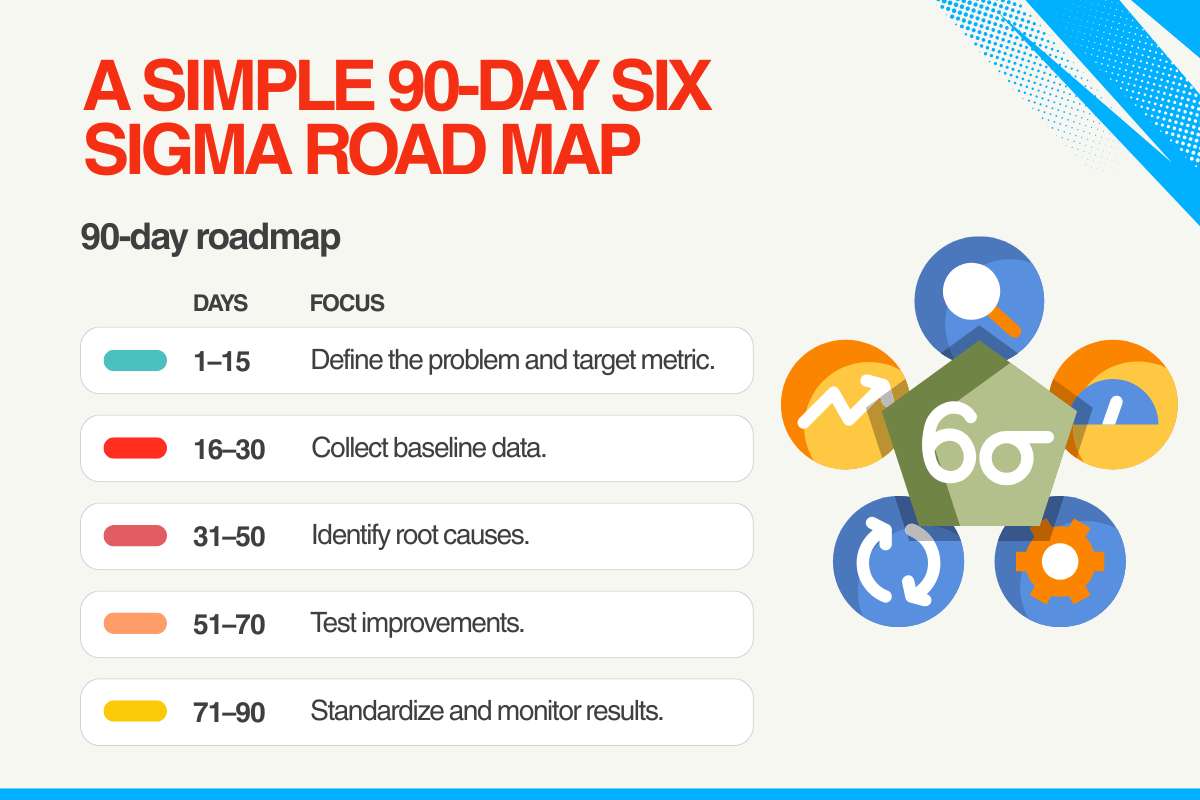
A simple 90-day Six Sigma roadmap keeps the project small, measurable, and easy to follow. It helps teams move from problem definition to stable results without overcomplicating the work.
90-day roadmap
| Days | Focus |
| 1–15 | Define the problem and target metric. |
| 16–30 | Collect baseline data. |
| 31–50 | Identify root causes. |
| 51–70 | Test improvements. |
| 71–90 | Standardize and monitor results. |
This sequence follows the DMAIC flow used in Six Sigma: Define, Measure, Analyze, Improve, and Control. It keeps attention on the process, the data, and the result. What is Six Sigma process improvement? It is a structured method for improving business processes by reducing defects and variation.
Simple execution tips
- Keep the scope narrow so the team can finish in 90 days.
- Pick one clear metric, such as cycle time, defects, or errors.
- Use baseline data before testing any changes.
- Document the best fix and assign an owner for control.
- Review results weekly so issues do not drift.
Why it works
This roadmap is practical because it turns Six Sigma into short, visible steps. It is easier for teams to act on than a broad theory-heavy plan. It also gives readers a clear path they can apply immediately.
Conclusion:
What is a Six Sigma process improvement? It is a practical, data-driven method for reducing defects, variation, and waste in repeatable processes. Choosing the right process can improve quality, speed, and cost without overcomplicating the work. The key is to start small, follow DMAIC, and focus on changes that can be measured and sustained. If your process is error-prone, slow, or inconsistent in its results, it’s time to take a closer look at Six Sigma.
Ready to evaluate a process in your business and determine if Six Sigma is the right fit?
FAQ:
Is Six Sigma difficult to learn?
Six Sigma isn’t universally difficult, but it scales in complexity depending on the certification level (or “belt”).
What is process improvement in Six Sigma?
Six Sigma is a data-driven process improvement strategy that minimizes defects and process variation.
What is the Six Sigma salary?
Six Sigma salaries range from $57,000 to over $180,000 annually.
What is 6 sigma in simple terms?
Six Sigma is a business method that uses data and statistics to eliminate mistakes, reduce variation, and improve the quality of a company’s products or services.
Can I learn Six Sigma on my own?
Yes, you can absolutely learn Six Sigma on your own. Millions of professionals successfully self-study using online courses, books, and practice exams before testing for their certification.
Links and Sources:
https://www.ncbi.nlm.nih.gov/books/NBK589666
https://www.sixsigmaonline.org/six-sigma-continuous-process-improvement