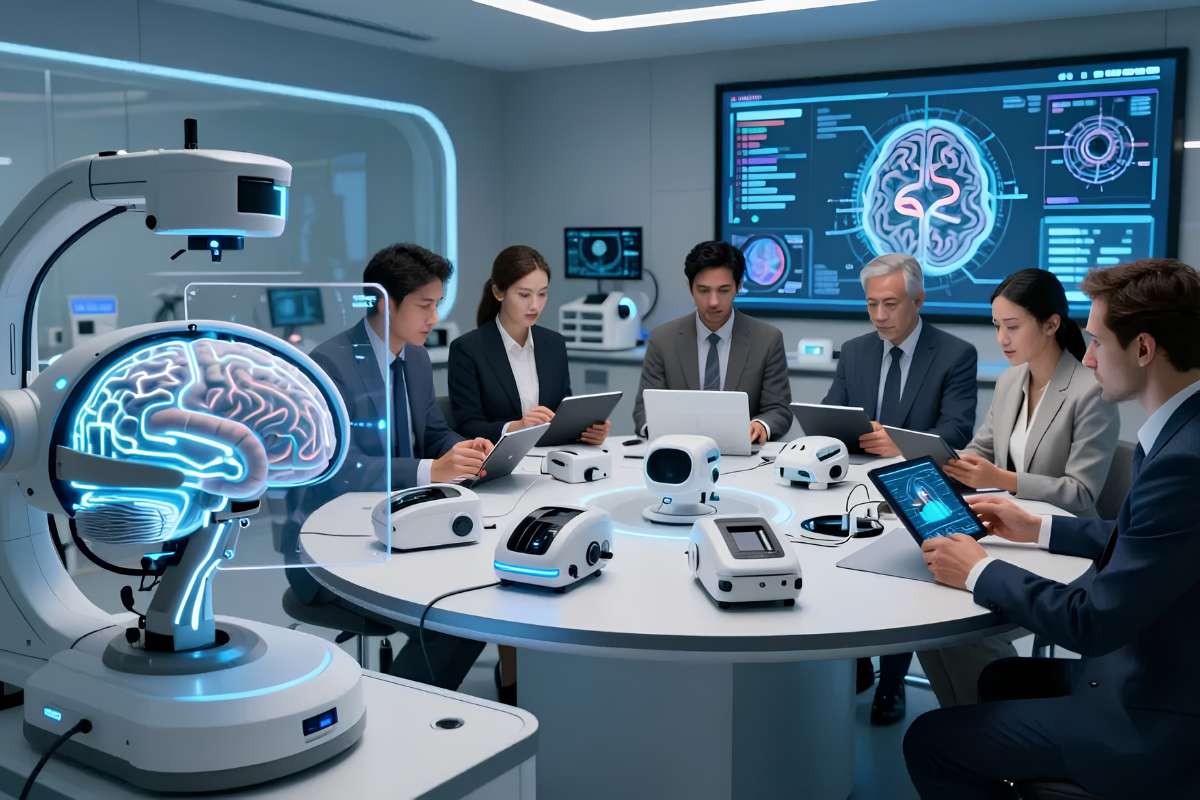
A real-world example of BCI spans healthcare, gaming, security, and UX research. Examples include Neuralink letting paralyzed patients control digital devices and smart headsets tracking gamer stress or consumer attention. These implications bring biological data directly into medical recovery and product design. Read on to find out how the technology works and future AI roadblocks.
Can you imagine speaking at full speed without moving a single muscle? Researchers at the University of California, San Francisco, achieved exactly that by decoding brain activity into text at 62 words per minute.
This milestone proves that Brain-Computer Interfaces (BCIs) are shifting out of experimental laboratories.
Understanding a real-world example of BCI is no longer a futuristic exercise. It is a necessary framework for the future of human-machine interaction. To see how this technology is shifting modern industry, we first need to look at the mechanics behind the magic.
How Do Brain-Computer Interfaces Actually Work?
At its core, a Brain-Computer Interface (BCI) acts as a direct translator between the human mind and digital devices. It intercepts the tiny electrical signals naturally generated by your brain cells and converts them into code that software can read. This means a user can control a computer, a robotic arm, or a digital application entirely without relying on physical muscles or nerves.
This shift marks the dawn of a completely new human-machine interface. It introduces an unfiltered data source that turns direct cognitive intent into actionable enterprise metrics. But enough with the theory, let’s see how this is playing out in the wild and look at the real-world applications transforming different industries right now.
How Rising Healthcare Implications Offer a Real World Example of BCI?
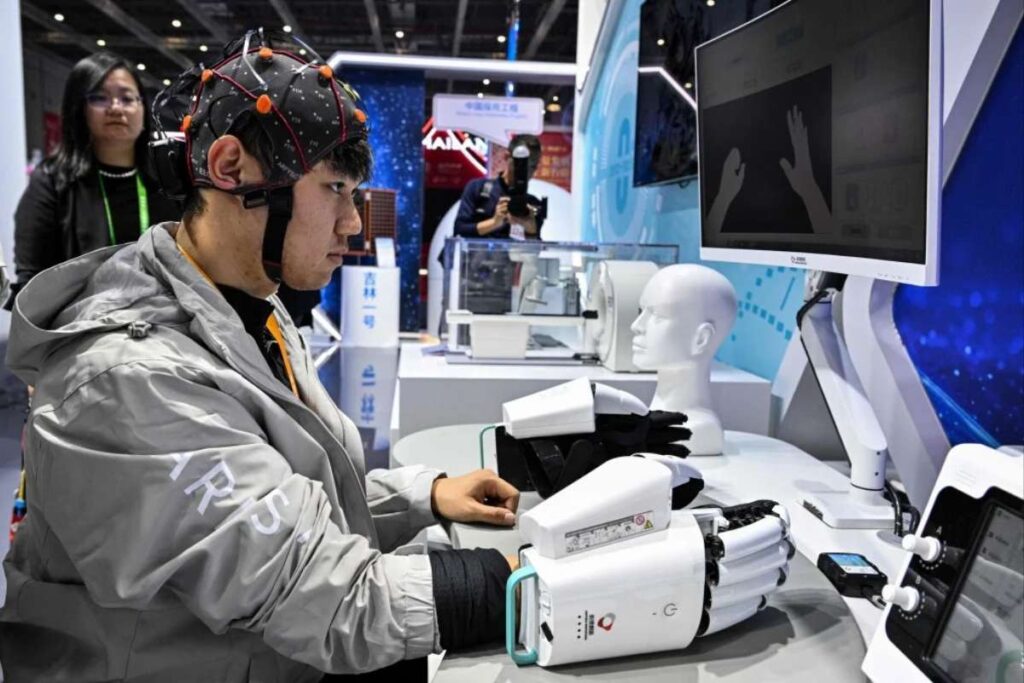
BCI technology is making its biggest waves in medicine. It is moving quickly out of research labs and into real clinics to change human lives.
Here is how healthcare teams use brain-computer interfaces to restore independence today:
1. Rebuilding Lost Speech
BCI systems restore speech by targeting the areas of the brain that control the muscles used for talking, like the lips, tongue, and jaw. Even when a person loses the physical ability to speak, the brain still fires these motor commands whenever they try to form words. The implant picks up these intended movement signals and instantly translates them into spoken words through a digital voice speaker.
For example, a stroke survivor named Ann lost her ability to speak. A breakthrough implant reads her brain signals and sends them to a computer. Now, a digital avatar speaks her thoughts out loud and copies her facial expressions in real time.
2. Controlling Computers with Pure Thought
Paralyzed patients are using high-tech brain chips to navigate the digital world. By simply thinking about moving a hand, they can play online video games, scroll the internet, and use social media entirely on their own.
Noland Arbaugh became the first human to receive a Neuralink brain chip as part of a clinical trial. By simply imagining moving his hand, Noland can control a computer cursor. He now uses his thoughts to browse the web, text friends, and play complex online video games like Civilization VI.
3. Walking Again via a “Digital Bridge.”
People with severe spinal cord injuries are standing up and taking steps. A wireless BCI reads their mental intent to walk. It instantly sends those signals to their leg muscles, completely bypassing the broken nerve pathways.
4. Navigating the World Through Blood Vessels
Mark is a 64-year-old patient living with ALS (Lou Gehrig’s disease), a condition that takes away muscle control. Instead of open-brain surgery, doctors slid a flexible BCI implant inside the blood vessels near his brain using a tiny tube. Using this device, Mark can wirelessly tap options on a tablet to control his smart home lights, stream TV shows, and shop online voice-free.
5. Retraining the Brain After a Stroke
Medical teams are using non-invasive BCI setups to help patients recover lost motor skills. To see how this works in clinics, we recently interviewed Dr. Christoph Guger, a neurotech pioneer and co-founder of g.tec medical engineering. During our conversation, he broke down his team’s system, recoveriX, which builds a closed-loop learning setup for the brain: when a patient imagines moving a paralyzed hand, the Example of BCI catches that brainwave pattern, instantly triggers an on-screen avatar, and sends a safe electrical pulse to the muscle to make the hand actually move.
Real World Example of BCI in Gaming and Immersive Experiences
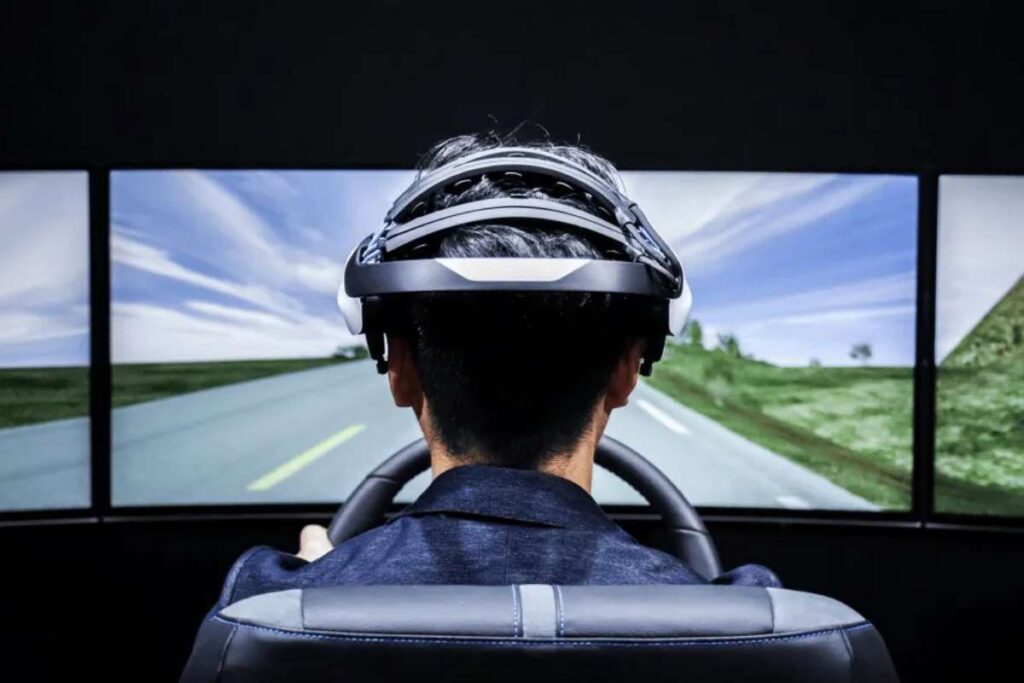
Imagine entering a virtual world that shifts its environment based on your stress level. Software engineers are building this reality today, which integrates hardware sensors into premium virtual reality headsets. Instead of relying solely on handheld controllers, this system captures multi-modal data directly from the user’s scalp and face.
This technology changes spatial computing completely. It turns a simple display headset into a smart tool that responds to your body. The hardware tracks ten channels of brainwaves while watching your eyes and facial muscles move. This lets software engines measure your stress and attention right as it happens. The digital world can then automatically change its story or difficulty level based on exactly where you are focusing.
This opens up entirely new product lines in interactive media, where software success is measured by direct cognitive immersion rather than simple screen clicks.
BCIs for Training, Safety, and Productivity
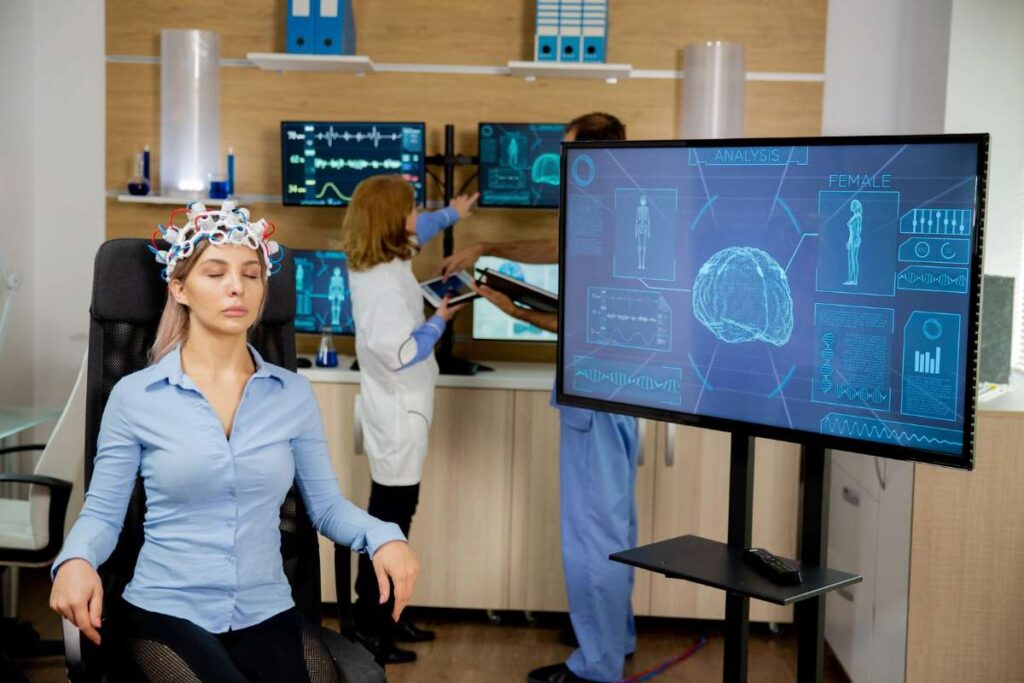
Heavy haul truck operators at a prominent mine in Hunter Valley, Australia, are currently protecting themselves using brainwave tracking. These drivers wear a flexible sensor band slipped directly into their standard hard hats or baseball caps. The band reads raw brainwaves to determine operator alertness levels on long shifts.
This wearable tech is a massive win for workplace safety and training. The system checks shifting brainwaves to measure tiredness. It then sets off early warning alarms before a worker falls into a dangerous, split-second sleep. According to project safety data, operators successfully fixed their own alertness 97.7% of the time after receiving a warning.
Emerging Business Use Cases: Neuromarketing, UX Research, and Beyond
Global consumer brands are moving away from old-school focus groups. Instead, marketing teams use comfortable brainwave headsets to test new ideas. While a person uses a new app or watches an ad, researchers can see second-by-second changes in their attention and mood.
This method takes the guesswork out of product testing. By seeing how hard the brain is working, design teams can spot exactly where a user gets confused by an app or website. It brings real, biological facts into creative business choices.
What are the Biggest Roadblocks Facing BCI Adoption?
Seeing someone walk again using mind-controlled signals is incredible. However, moving any real-world example of BCI out of the lab and into widespread enterprise adoption is a massive undertaking.
The primary challenges standing in the way include:
- Biological Barriers: The body is a harsh environment for electronics. Implants face tissue scarring that weakens signals over time, while non-invasive sensors struggle to read clean data through a thick skull.
- Regulatory Hurdles: Approval from global health agencies takes years of strict safety trials. The U.S. Government Accountability Office (GAO) notes that clear standards for consumer neurodata do not exist yet.
- Ethical Concerns: Mind-reading tech raises major questions about data ownership and cognitive liberty. Leaders must protect users from predatory tracking before these devices become mainstream.
How is the Synergy Between AI and BCI Shaping the Future?
Brain-computer interfaces rely entirely on artificial intelligence to work. Raw brain signals look like random static to the human eye. Advanced AI models act as the translator, turning that neural noise into clear digital commands. Right now, software developers use these algorithms to predict what a user wants to do next. This cuts down system delays and makes the tools feel instant.
In the interview, Dr. Guger explained that the mathematical models used to decode brainwaves are identical to the systems used to analyze factory sounds and industrial machine data. Because they share this same foundation, any real-world example of BCI automatically improves whenever general enterprise AI gets smarter. As a result, companies do not need to waste time or capital building new neural code from scratch.
In the future, this partnership will let people write code or design products using pure thought. Instead of typing prompts or clicking menus, humans will work alongside AI tools at the speed of thought, turning computing into a seamless mental collaboration.
What is the Role of Leaders in Driving Neurotech Innovation?
Enterprise leaders must prepare for neurotech by building flexible data systems that handle high-speed biometric inputs. Instead of building new neural hardware from scratch, which wastes time and capital, leaders should follow the advice of Dr. Christoph Guger and focus entirely on developing great software applications on top of existing, proven hardware platforms. Funding needs to target lightweight, comfortable wearables that employees will actually want to use for safety or focus tracking. Finally, as states like Colorado expand privacy laws to protect human brainwaves, leaders must establish strong ethical boundaries to manage this sensitive biological data safely.
Conclusion:
Brain-Computer Interfaces are no longer confined to the pages of science fiction. From restoring natural speech to tracking industrial fatigue, finding a real-world example of BCI is becoming easier as neurotech expands rapidly across healthcare and enterprise sectors alike. For modern technology and business leaders, the question is no longer if you will integrate neural data pipelines, but when. The organizations that win the next decade will be those that actively prepare their infrastructure, data governance, and security models for the mind-machine node today.